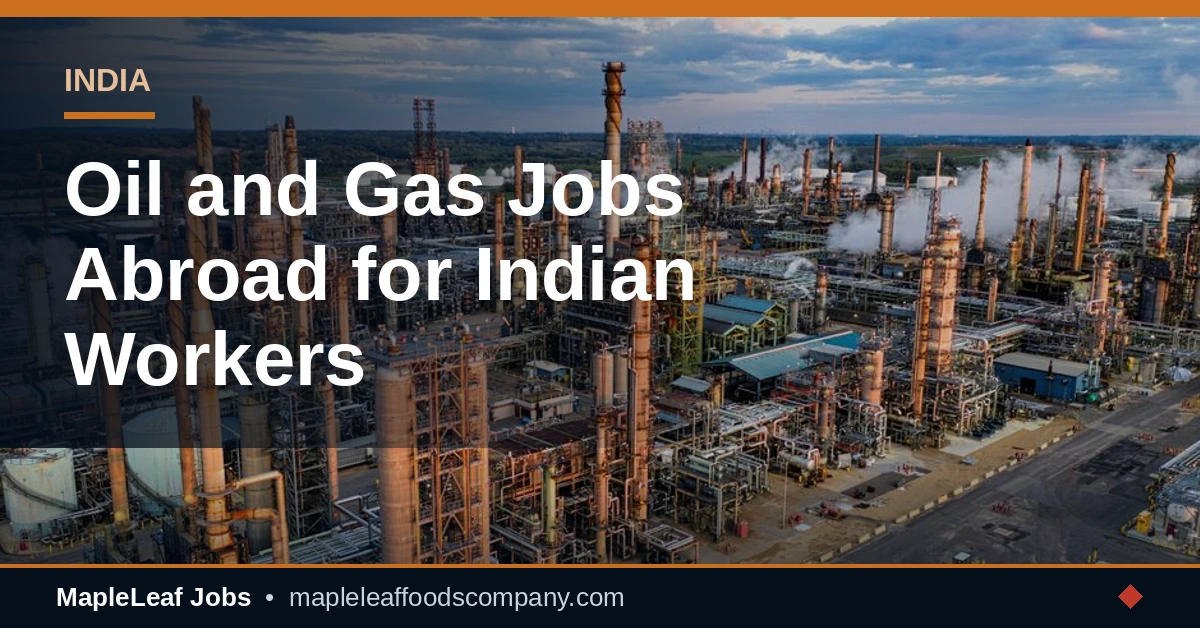
Oil and Gas Jobs Abroad for Indian Workers
Oil and gas jobs abroad for Indian workers: the roles open to skilled and semi-skilled workers, safety training, contractors, and safe ways to apply.
India · Working Abroad · Jobs & Visa Guidance
Oil and gas is one of the largest employers of Indian workers in the Gulf, and it covers far more than drilling. Refineries, petrochemical plants, pipelines, maintenance yards and support services all need welders, fitters, pipe fabricators, riggers, electricians, mechanics, drivers, scaffolders and general workers. For an Indian worker with trade skills and a safety-first attitude, the sector offers structured work with established employers, though the hiring chain and the safety rules need to be understood before applying. Pay for any role is to be confirmed with the employer during recruitment.
MapleLeaf Jobs is an independent international jobs and visa guidance service. It is not affiliated with Maple Leaf Foods, the food company.
Roles Open to Indian Workers
The best-known roles are the skilled trades: welders, pipe fitters, fabricators, riggers, scaffolders, electricians, instrument technicians and mechanics. These workers build, maintain and repair the plants, pipelines and equipment that keep oil and gas moving. Semi-skilled roles include helpers, general workers, store keepers, drivers and security staff who support the site. Office and camp support roles, such as cooks, cleaners and clerks, are hired too, though this guide focuses on the trade and site roles.
Each trade has its own standards. A welder may be asked to demonstrate a particular welding position, a rigger may need to show knowledge of lifting signals and slinging, and a scaffolder may need to show that a scaffold has been built safely. The Saudi oil and gas jobs guide describes the work in the region's largest market, and the India welders and fitters guide covers two of the most hired trades. Openings and guidance are listed on jobs, with wider reading in articles.
Onshore Work and Offshore Work
Most Indian workers in the sector work onshore, in refineries, petrochemical plants, fabrication yards and pipeline projects. Onshore work usually means living in a camp or in town, travelling to the site each day, and working a regular rotation of days on and days off. Offshore work takes place on platforms and rigs at sea, where workers live on the platform for a rotation and then return to shore for rest. Offshore roles carry extra medical and safety requirements and are generally harder to enter without prior offshore experience.
A worker should understand which kind of site the offer covers before accepting it, because the living arrangements, the safety training and the daily routine differ a great deal between onshore and offshore work. An offer that does not say clearly where the work takes place should be questioned. The India engineers and technicians guide gives useful background on the technical side of the sector.
Safety Training and Certificates
Safety is the defining feature of oil and gas work, and employers treat it seriously. Basic safety induction is given on arrival, but many roles also need certificates obtained before departure or during the first weeks, covering areas such as working at height, confined spaces, fire safety and first aid. Offshore roles need additional survival and sea safety training. A worker should ask the employer or recruiter which certificates are needed for the specific role, and should obtain them only from recognised providers.
Trade certificates matter too. An ITI certificate, a polytechnic diploma or a recognised trade test result strengthens an application, and a trade test is a normal part of hiring in this sector. Genuine employers test skills directly, often through a practical assessment at a test centre, rather than relying on paper alone. A worker who can demonstrate the trade confidently will always stand out.
The Hiring Chain: Contractors and Clients
Oil and gas hiring rarely happens directly with the oil company. The main company awards a project to a contractor, and the contractor hires the workers, sometimes through a further subcontractor. That chain is normal, but it means the worker should know exactly which company is the employer, which company is the client, and where the site is. The written offer should name the employer clearly.
Because the chain has several links, scams can hide in it. A middleman who claims to represent a famous oil company, but cannot show a written offer naming a real employer, should not be trusted. The agent licence check guide explains how to verify a recruiter, and the fake job offer letters guide shows what a dishonest offer looks like. No one can guarantee a job in oil and gas, whatever they claim.
Documents and Medical Checks
The passport comes first: valid, with correct details and a clear photograph. For Gulf destinations, workers in the ECR category need emigration clearance before departure, while ECNR workers do not. The ECR and ECNR guide explains both categories, and the eMigrate registration guide covers the official clearance system.
Medical examinations are a normal part of the process, and the standards can be strict for site and offshore work, because the work is physically demanding and medical help may be far away. A police clearance certificate is commonly requested as well, and the police clearance guide for Indian workers explains how it is obtained. Originals should stay with the worker, with copies supplied to the employer or recruiter. When the papers line up, the worker can begin through apply.
Life on Site and in Camp
Site life is disciplined: safety briefings, protective equipment, set meal times and a fixed rotation. Camps usually provide shared rooms, meals, laundry and transport to the site, and workers from many countries live side by side, with Indians often forming a large group. The routine can feel repetitive, but workers who settle into it, keep fit and build good relations with supervisors and colleagues usually do well.
Money sent home is a major reason workers choose the sector, and licensed exchange services are widely available. Workers should keep copies of their contract, their visa and their pay slips, and should know where to seek help if a problem arises at work. A careful start, with the employer verified and the papers in order, sets the tone for the whole contract.
Scam Protection
Oil and gas scams often use the name of a famous energy company and promise a high-paying role with no trade test and no interview. Never share full passport details, a passport copy, bank details, passwords or one-time codes with anyone unverified. Verify the employer and any agent's licence through official channels first. Never pay a fee just because someone promises a guaranteed job or visa. Never send money to a personal bank account. Nobody can sell you a job, a work permit or a visa, and nobody can promise you a guaranteed outcome. Anyone who claims they can is almost certainly running a scam. Before paying anything, check the recruiter and compare the offer with how to spot fake job offer letters.
Frequently asked questions
Which oil and gas roles are open to Indian workers?
Welders, fitters, fabricators, riggers, scaffolders, electricians, instrument technicians, mechanics, drivers and general site workers are among the roles most often hired from India.
Is oil and gas work onshore or offshore?
Most Indian workers in the sector work onshore, in refineries, plants, yards and pipeline projects, while offshore roles on platforms and rigs carry extra medical and safety requirements and usually need prior offshore experience.
Do I need safety certificates for oil and gas jobs?
Basic safety induction is given on arrival, and many roles also need certificates covering areas such as working at height, confined spaces and first aid, obtained from recognised providers.
How does hiring work in oil and gas?
The main company usually awards a project to a contractor, and the contractor hires the workers, so the written offer should name the actual employer clearly, and a trade test is a normal part of the process.
Do I need emigration clearance for a Gulf oil and gas job?
Workers whose passports carry the ECR note generally need emigration clearance before leaving India for employment in the Gulf, while workers with ECNR do not need that clearance.
Disclaimer
No job, sponsorship or visa is promised. Final decisions rest with employers and immigration authorities. Rules vary by job, employer and programme and change over time. Pay is to be confirmed with the employer during recruitment. This guide is general information only, not legal or immigration advice.
Apply for jobs abroad
Ready to apply? Browse current jobs and apply with your documents ready.