How to Verify a Job Offer Letter Is Real: 10 Checks Before You Trust It
How to Verify a Job Offer Letter Is Real: 10 Checks Before You Trust It
By MapleLeaf Foods Company | Published 9 November 2026
Published 9 November 2026
A job offer letter can change your life — or ruin it. A real offer opens the door to a legal job, a proper visa and a safe journey abroad. A fake one can cost you your savings, your passport details and months of your time. Fake letters are often well made, with logos, stamps and signatures that look convincing. The only protection is to check the offer step by step, before you pay anything, share documents or travel.
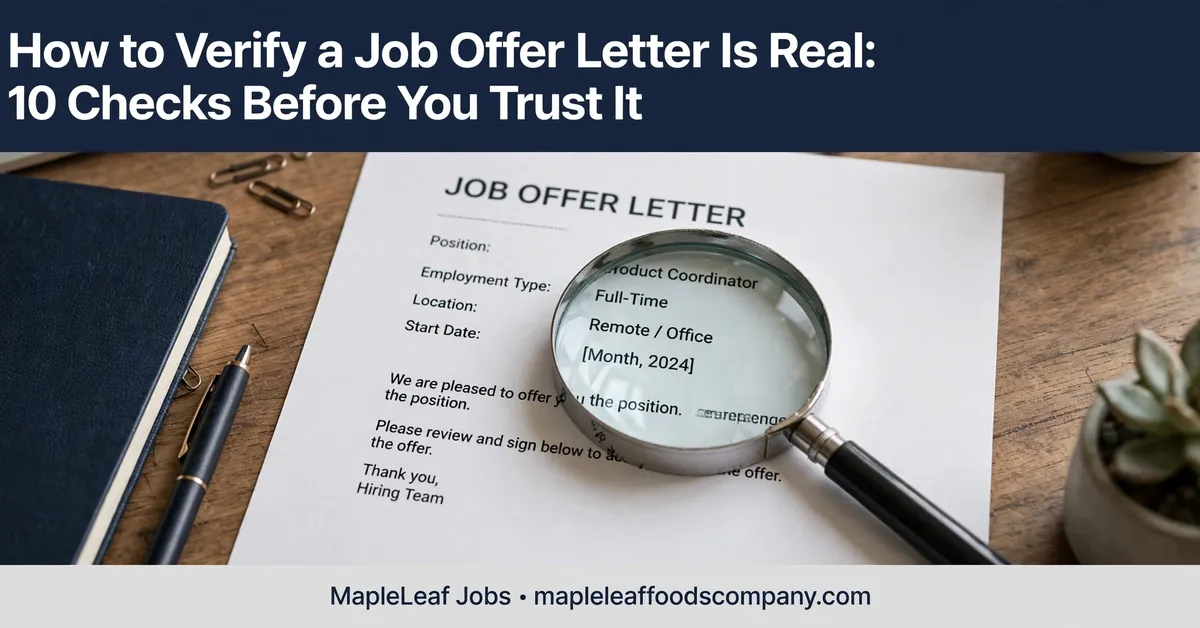
This is general guidance only. Offer and visa processes vary by country, employer and programme, and a verified offer never guarantees a visa — the final decision rests with the immigration authorities. Salary is to be confirmed with the employer during recruitment.
Check 1: Find the employer through official channels, not the letter
Do not trust the contact details printed on the offer letter — a scammer controls those. Find the employer's official website, phone number and email address independently, and contact the employer through those channels to confirm the offer, the job title and the recruiter's name. If the employer has no verifiable online presence or official contact page, treat that as a serious warning: a real employer can be found and contacted.
Check 2: Read every word of the offer, slowly
Read the whole letter, not just the job title and the salary figure. A real offer names the employer, the job title, the duties, the place of work, the working hours, the contract length and the notice and leave terms in clear language. Check for spelling mistakes, poor grammar, vague duties, missing addresses and inconsistent details, such as a job title that does not match the duties, or a company name spelled two different ways. If the letter is only a few lines long, or if it promises a high salary for vague work with no clear duties, be suspicious.
Check 3: Check the salary and benefits against reality
If the salary looks far higher than normal for the role and your experience, be cautious. Pay is to be confirmed with the employer during recruitment, and a genuine offer states pay and benefits in the contract, not in a separate message. Be wary of offers that promise free accommodation, food, flights and a large salary all at once, or that change the salary figure between messages. Ask the employer directly, through official channels, to confirm the terms in writing.
Check 4: Confirm the recruiter and the agent licence
Find out exactly who sent you the offer: the employer's own HR team, or a recruitment agent. If it is an agent, ask for the agency's full legal name, licence number and office address, and verify the licence through the official government regulator in your country before you pay or share anything. If the agent refuses to give licence details, gives a licence that cannot be found, or pressures you to pay quickly, stop. For related guidance, see our Fake Job Offer Letters guide.
Check 5: Look at how you are being contacted
Real employers and licensed agents use official email addresses, proper company domains and professional communication. Be suspicious of offers sent only through a personal email address, a messaging app account with no company identity, or a phone number that cannot be traced to the employer. Check whether the sender's email domain matches the employer's official website domain. Be wary if the recruiter refuses a video call or insists on communicating only through chat.
Check 6: Never pay to receive the offer or the visa
A real employer does not ask you to pay for the offer letter itself, and does not ask for payment to a personal bank account or an untraceable method. Be extremely cautious of any request for a "processing fee", "visa fee", "security deposit" or "training fee" paid directly to an individual before you have a verified contract and a visa process through official channels. Ask for the exact purpose of every fee and the official payment channel, and verify it independently. Being told to pay urgently or lose the offer is itself a warning sign.
Check 7: Check the visa route through official sources
A job offer is not a visa. Ask which visa category it is and which authority will issue it, then check that route on the official government immigration website. If the recruiter cannot name the visa category, tells you to travel on a visit visa and "convert" it later, or promises that the visa is guaranteed, be very cautious. Visa rules vary and change over time — check official government sources before applying. A promise of a guaranteed visa is a red flag.
Check 8: Ask for the contract, and read it before signing
Ask for the full employment contract, not just the offer letter, and read every clause before you sign: duties, hours, overtime, accommodation, transport, medical cover, leave, end-of-service terms and notice periods. If the contract is in a language you do not understand, get it translated by someone you trust, and never sign a blank or incomplete document. If the contract differs from the offer letter, ask why in writing. For related guidance, see our Contract Red Flags guide. Never sign a contract you have not read, and never let anyone sign on your behalf.
Check 9: Verify the documents, stamps and signatures
Stamps, logos and signatures are easy to copy, so they prove nothing on their own. Check whether the letter is on proper company letterhead, whether the signatory's name and role are stated, and whether the employer can confirm it through official channels. If the recruiter claims the offer is attested or approved by a government body, ask which body, and verify that claim independently.
Check 10: Pause, keep records, and get a second opinion
Before you pay, share documents or travel, pause, and keep copies of every message, email, letter and payment request, with dates and names. Show the offer to a trusted person or a licensed agent verified through official channels, and ask for a second opinion. If anything feels rushed, secretive or too good to be true, trust that feeling and check again. If you discover the offer is fake, stop all contact, do not send money or documents, and report it through official channels. For related guidance, see our Spot a Fake Job Offer guide and Scammed: What to Do guide.
For related guidance, browse current job listings, read all guides, and use the apply route when you are ready. Applying does not guarantee a job, a visa or sponsorship.
Scam protection: check before you share or pay anything
Never share full passport details, a passport copy, bank details, passwords or one-time passwords (OTPs) with anyone unverified. Verify the employer and the agent licence through official channels first — not through a phone number or email address given only by the recruiter. Never pay a fee just because someone promises a guaranteed job or visa, and never send money to a personal bank account. A genuine employer or licensed agent will not ask for your password or an OTP, and will not need your original documents before a verified offer process. Pause if there is urgency, secrecy, or a request for passwords or banking details. Pressure to decide today and instructions to keep the offer secret are warning signs, not normal recruitment.
Frequently asked questions
Can a fake offer letter look completely real?
Yes. Fake letters often copy real logos, stamps and signatures. Logos and stamps prove nothing — only verification with the employer through official channels proves an offer is real.
Should I pay a fee to receive my offer letter?
Be extremely cautious. A real employer does not ask you to pay for the offer letter itself, and never asks for payment to a personal bank account. Verify every fee independently first.
What if the recruiter says the offer will expire today?
Treat urgency as a warning sign. A real employer will wait while you verify; a scammer pressures you to decide before you can check.
Is a job offer the same as a visa?
No. The visa is applied for separately, and the final decision always rests with the immigration authorities. Check the visa route on the official government website.
What should I do if I find out an offer is fake?
Stop all contact, do not send money or documents, keep copies of every message and letter, and report it through official channels.
Disclaimer: This article is general information only. Offer, contract and immigration rules vary by country, employer and programme, and they change over time. No job, sponsorship or visa is guaranteed; final decisions rest with employers and immigration authorities. Salary is to be confirmed with the employer during recruitment. Always check official government and employer sources before applying, paying any fee, signing a contract or travelling.
Apply Now
Apply Now: If you decide to apply through this site, use the Apply Now option on the Jobs page and follow the steps shown there. Do not send passport copies, bank details, passwords or payments by email or message to an unverified person. Apply only through the official route shown on this site, and check the details on the application page before you submit anything.