What to Pack for Your First Job Abroad: A Complete Checklist
What to Pack for Your First Job Abroad: A Complete Checklist
By MapleLeaf Foods Company | Published 9 November 2026
Published 9 November 2026
Packing for your first job abroad is different from packing for a holiday. You are moving your life, not just taking a trip, and you will need the right documents, enough money for the first weeks, and the essentials that will get you through your first days in a new country. Packing too much is a common mistake — luggage is heavy, expensive and hard to move — but forgetting an essential document or medicine is worse. Use this checklist to pack smart, travel light and arrive prepared.
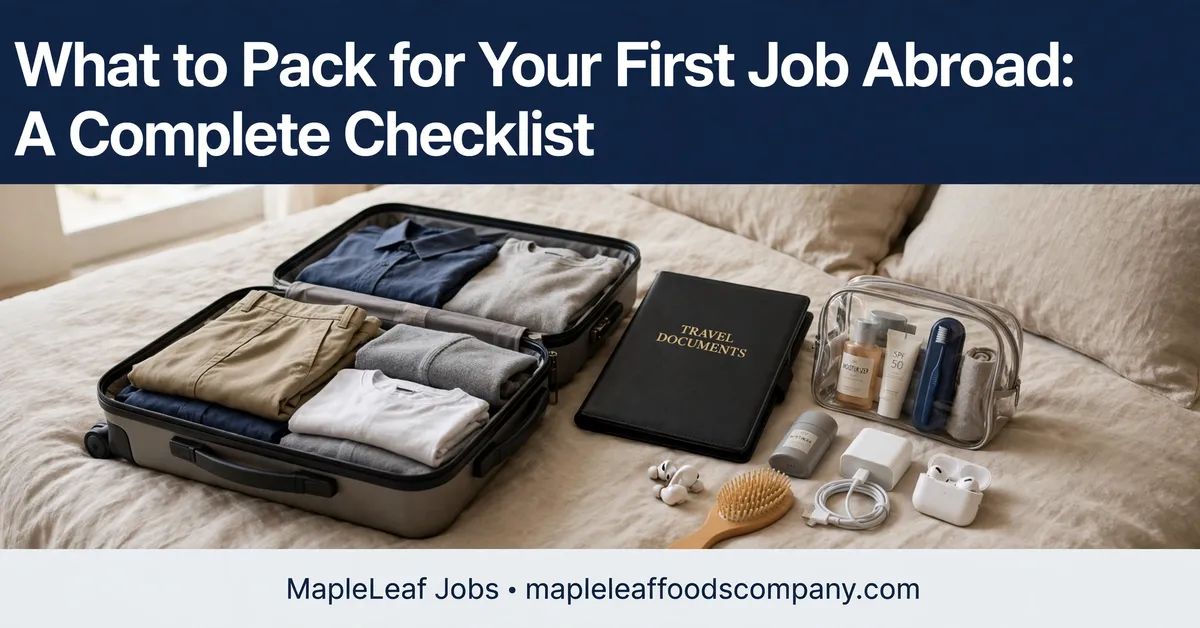
This is general guidance only. Baggage rules, customs rules and document requirements vary by airline, country and employer, and they change over time. Always check the official government sources and your airline's rules before you travel. No job, sponsorship or visa is guaranteed; final decisions rest with employers and immigration authorities.
Documents first: the folder you never let go
Your documents are the most important thing you will carry, so keep them in a folder in your hand luggage, never in checked baggage. Carry your passport, your visa or work permit, your employment contract, your offer letter, your medical and police clearance certificates if you hold them, your educational and trade certificates, and any attested documents your employer or the immigration authorities asked for. Carry several photocopies of each document, stored separately from the originals, and keep digital copies in a secure place you can access if the originals are lost. Keep the employer's official contact details, your accommodation address and the address of your country's embassy in the destination written down as well as on your phone. Before you leave, check the expiry dates on your passport and every certificate, and confirm with your employer which originals you must bring — do not assume.
Money: enough for the first weeks, in the right form
Take enough money to cover food, transport and small essentials for your first two to three weeks, in case your first pay is delayed. Carry a mix of cash in the destination currency and a bank card that works abroad, and tell your bank you are travelling so the card is not blocked. Keep your cash split between your wallet and a secure place in your luggage, and never carry all your money in one place. Do not carry large amounts of cash unnecessarily, and check the customs rules for how much cash you may carry into the destination country. Keep receipts for any fees you have paid, and keep your employer's official payment details separate from any personal bank details. Never send money to a personal bank account on the promise of a job or visa, and never hand your bank card or PIN to anyone.
Clothes and work essentials: pack for the job, not the holiday
Pack clothes for the climate and the job. If you are going to the Gulf, pack light, breathable work clothes and modest dress suitable for the workplace and public places. If you are going to Canada or the UK, pack warm layers, a waterproof jacket and sturdy shoes, because the weather changes quickly. Pack enough for one week, because you can buy more after you arrive and are paid. Include work shoes or boots if your employer has not said they will provide them, and any personal protective items you normally use. Pack a small set of formal clothes for interviews, meetings or official appointments. Check with your employer before you travel whether uniforms, safety shoes or tools are provided, so you do not carry heavy items you do not need.
Health, medicines and personal care
Carry any regular medicines in their original packaging, with the prescription and a doctor's note, and carry enough for at least the first month. Check whether your medicines are allowed in the destination country before you travel, because some medicines are restricted. Pack a small first-aid kit with pain relief, plasters, antiseptic and any personal care items you use daily. If you wear glasses or contact lenses, carry a spare pair and your prescription. Pack toiletries for the first few days only — shampoo, soap, toothpaste and a towel — because these are easy to buy after arrival. Keep your vaccination record and any medical certificates with your documents folder, not in your checked luggage.
Electronics, chargers and staying in touch
Your phone is your lifeline in the first weeks, so pack it, its charger, a power bank and the right plug adapter for the destination country. Check the voltage and plug type before you travel. Keep a list of important phone numbers written on paper as well as on your phone, including your family, your employer and your embassy. Pack a small padlock for your luggage and for lockers at work or in shared accommodation. Do not pack expensive electronics you do not need, and do not carry anyone else's luggage or packages. When you arrive, buy a local SIM card through an official shop with your passport, so you can call your family and your employer.
What not to pack, and the final check
Do not pack prohibited items: check the destination country's customs rules for food, medicines, plants, alcohol and other restricted goods, and do not carry items for strangers. Do not pack your original documents in checked luggage. Do not pack more than you can carry yourself, because you may need to move your bags alone through airports and to your accommodation. The night before you travel, lay everything out and check it against this list: documents folder, money and cards, clothes for one week, medicines, phone and charger, toiletries for a few days, and the employer's contact details. Weigh your bags against the airline's allowance, label every bag with your name and phone number, and keep your hand luggage light enough to carry comfortably. Arriving organised is the best start to a new job abroad.
For related guidance, see our Documents Checklist guide, browse current job listings, read all guides, and use the apply route when you are ready. Applying does not guarantee a job, a visa or sponsorship.
Scam protection: check before you share or pay anything
Never share full passport details, a passport copy, bank details, passwords or one-time passwords (OTPs) with anyone unverified. Verify the employer and the agent licence through official channels first — through the official contact page or an official government source, not through a phone number or email address given only by the recruiter. Never pay a fee just because someone promises a guaranteed job or visa, and never send money to a personal bank account. A genuine employer or licensed agent will not ask for your password or an OTP, and will not need your original documents before a verified offer process. Pause if there is urgency, secrecy, or a request for passwords or banking details. Pressure to decide today and instructions to keep the offer secret are warning signs, not normal recruitment. Keep your documents with you at all times while travelling, and do not hand your passport to anyone except an official at a border, an embassy or a verified employer process.
Frequently asked questions
Should documents go in hand luggage or checked luggage?
Always in hand luggage, in a folder you keep with you. Never put your passport, visa, contract or original certificates in checked baggage, which can be delayed or lost.
How much money should I take for my first job abroad?
Enough to cover food, transport and small essentials for your first two to three weeks, in case your first pay is delayed. Carry a mix of cash and a bank card that works abroad.
What clothes should I pack for the Gulf?
Light, breathable work clothes and modest dress suitable for the workplace and public places. Pack enough for one week, and buy more after you arrive and are paid.
Can I carry my regular medicines abroad?
Yes, in their original packaging with the prescription and a doctor's note, with enough for at least the first month. Check first whether your medicines are allowed in the destination country.
What should I not pack?
Do not pack prohibited items, original documents in checked luggage, more than you can carry yourself, or anything for strangers. Check the destination country's customs rules before you travel.
Disclaimer: This article is general information only. Baggage, customs, health and immigration rules vary by country, airline, employer and programme, and they change over time. No job, sponsorship or visa is guaranteed; final decisions rest with employers and immigration authorities. Always check official government and airline sources, and seek regulated or official advice for your own case before applying, paying any fee or travelling.
Apply Now
Apply Now: If you decide to apply through this site, use the Apply Now option on the Jobs page and follow the steps shown there. Do not send passport copies, bank details, passwords or payments by email or message to an unverified person. Apply only through the official route shown on this site, and check the details on the application page before you submit anything.